
There has always been a debate about the benefits of steel beams vs. joists. Beams often win the battle of steel components, but it’s often due to some misinformation in the construction industry.
This blog separates the myths from the facts about beams and joists.
This misconception is a throwback to the COVID era, when lead times for joists grew to over 30 weeks as demand for warehouses skyrocketed around 2020. Today, turnaround times for steel joists from New Millennium are typically in the range of 12 to 20 weeks, depending on the complexity and location of the job. “We’re five years from 2021, when we were pushing out those really long lead times,” said Seamus Robins, National Accounts Sales Manager. “We still encounter a lot of people in the engineering and general contracting community who still think joists will take about 30-plus weeks. That isn’t the case.”
Even with most joists being fabricated to a customized specification, the lead times for joists are relatively quick because materials are already in stock at the fabricator.
And that customization period is another reason to engage with a supplier like New Millennium during the design phase of your project.
Loading the player...
Despite reduced weight, joists are engineered to meet the same structural performance requirements as their heavier counterparts – at a fraction of the cost. This reduction in steel tonnage creates efficiencies across the project, not just in the cost of steel. This reduction also lowers the amount of concrete required for the foundation and reduces carbon emissions as a result
Joists can be designed for greater spans than beams, reducing the amount of material required for columns, walls, and other supports. According to Sales Engineer Hossein Kashefi, Ph.D, MBA, P.E., wide-flange beams span 30 to 45 feet and could extend another 50 to 65 feet with additional treatment.
Joists can span up to 240 feet – almost four times the length of treated beams. “With the longer span capabilities of joists, there are fewer columns or walls that need to sit in the middle of the open space,” Kashefi said.
We have supplied steel joists for numerous data centers as this segment of the construction market soars. Owners and developers of these projects cannot wait out the extended lead times on steel beams, so joists have been substituted on many projects throughout the U.S.
“Joists can be fabricated to handle heavy loads that are needed per International Building Code (IBC) and other building standards,” Kashefi said. “I hear people say data centers can’t use joists because of heavy loads, but that’s not accurate.”
New Millennium was engaged by a technology company to supply steel joists and deck for a 715,000-square-foot data center located on a 280-acre site in northern Ohio.
Because of the floor clearance requirements at this data center, New Millennium’s LH-Series joists and joist girders were the ideal solution to cost-effectively achieve the required open spans for the column-free zones.
This project exemplifies the evolution in data center design. Initially, data centers featured a mezzanine level for their servers and other large, heavy equipment. This technology company now builds its data centers horizontally instead of vertically, creating floors that can support this hardware instead of suspending it overhead.
With this design, the only functions that are housed overhead are fire protection and MEP systems, which are routed through the open-web steel joists. The open web configurations also allow for easier adaptations to HVAC change orders.
Joists can often accommodate project load changes, utilizing commonly stocked materials at the joist fabricator, with minimal impact on the joist delivery schedule. However, significant load changes with beams may require altering the beam designation or size, significantly impacting the project schedule and availability.
Both joist and beams at floor systems require proper evaluation of stiffness, mass, and damping to achieve acceptable vibration performance.
Kashefi said 25 to 30 years ago, floor systems relying on steel joists had the reputation of being too “bouncy,” so engineers grew reluctant to specify them in their projects.
However, peer-reviewed research has shown that floor joists are a suitable choice for vibration performance, provided they are designed correctly for the application.
“There’s a myth that if you use joists in floor systems, you’ll have vibration problems, while beams won’t,” Dennis Montgomery, Licensed Structural Engineer, confirmed. “That’s simply not true – both systems can perform well or poorly depending on design and spacing.”
The Steel Joist Institute’s Technical Digest No. 5 has guidelines for computing the stiffness and choosing the right masses to use when evaluating vibration due to human activities, including when steel joists are part of the floor design. SJI also has a free vibration analysis tool.
Steel joists have taken a backseat to beams based on misconceptions in the industry for far too long. Joists are the option that offers longer clear spans with less material, which makes it a more sustainable steel building component with faster delivery times.
What’s not to like?
“It makes sense to look at other options besides beams, like steel joists,” Robins said. “Not as a fix, but to give owners real choices.”
When evaluated objectively, steel joists provide a compelling combination of efficiency, flexibility, and performance. Early collaboration with a joist manufacturer can further optimize system performance, cost, and schedule.

We called on our special team – the Memphis, Tennessee, architectural deck facility – to recruit a high-profile college football stadium project.
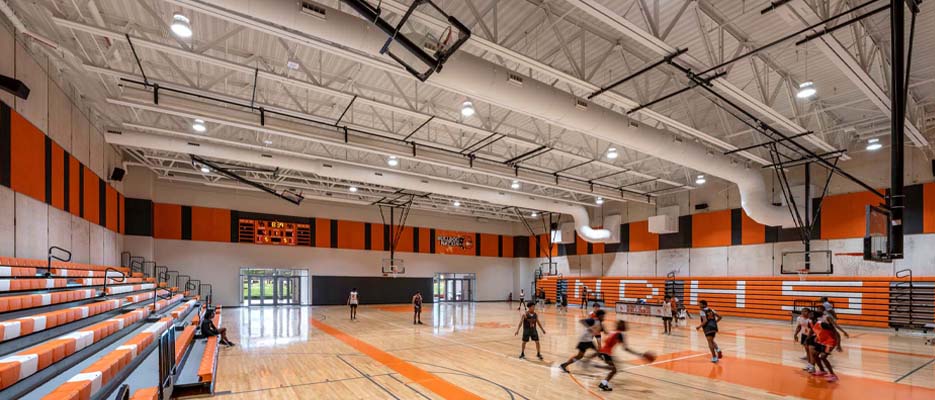
Storm shelters are necessities that can account for 10 to 20 percent of a project’s budget. Composite joist and deck solutions can turn these structures into cost-effective multipurpose facilities.
Building a better steel experience
